A Rulemaking to Hold Tri-State Accountable
The Colorado Public Utilities Commission is holding a rulemaking process through October 15th about Tri-State’s Electric Resource Plan (ERP), which will fundamentally impact co-op customers for years to come.
The ERP is a long-term energy plan that helps regulators and utilities decide where to invest resources for electricity and decide where that electricity comes from. Historically, Tri-State has not been required to file ERPs in the same way that investor-owned utilities (like Xcel) have. This spring, though, the Colorado Legislature required that the PUC adopt new rules to hold Tri-State’s ERP to higher standards.
Your comment makes a difference– we need you to speak out at the Colorado PUC and ask them to enact strong rules for Tri-State’s ERP to ensure that Colorado ratepayers have affordable, reliable, and responsible electricity.
Talking points and instructions for submitting comments below:
Tips for Comments
- Include the rulemaking docket number: 19-R-0408E
- Include your electric co-op if you know it (if you’re in La Plata or Archuleta counties, it’s La Plata Electric Association)
- Personalize it. Tell the PUC why this is an important issue in your community. If you’re a business owner or community leader, let them know too!

Image: Clean Cooperative
Talking Points & Asks
1. The PUC should require that Tri-State evaluates the cost of existing resources during its ERP to ensure that Tri-State is appropriately calculating the risks and costs of its expensive coal fleet
- Clean energy is more affordable than coal, and the PUC needs to evaluate the economics of Tri-State’s resources to make sure their rates are just and reasonable
- A 2019 Strategen report found that Tri-State’s Craig 1 and Craig 2 are the #1 and #3 most expensive coal units in Colorado
- A 2018 Rocky Mountain Institute report found that Tri-State members would save $600 million by shifting from coal to low-cost renewables
- A 2018 Vibrant Clean Energy report found that Colorado would save $2.5 billion through 2040 by retiring all remaining coal units by 2025
2. The PUC should require that Tri-State utilize the Social Cost of Carbon in its ERP to account for the health and environmental impacts of carbon emissions from its power plants
- The Social Cost of Carbon provides a monetary estimate of damages from greenhouse gases that cause climate change
- In 2018, wildfire suppression cost $130 million in Colorado, not including 12,000 damaged homes and 600,00 displaced people. These expenses will only grow as climate-induced wildfires get stronger
- Coal pollutants contribute to health problems ranging from asthma to brain damage, heart problems, cancer, neurological disorders, and premature death
- Southwest Colorado is particularly vulnerable to the effects of climate change, including increased drought, reduced snowpack, and more frequent and severe wildfires
3. The PUC should require that Tri-State consult with impacted workers to submit a workforce transition plan when proposing the retirement of an electric generating facility
- Impacted workers and communities deserve a just transition towards a clean energy economy
- SB-236, which became law last May, requires utilities to submit a workforce transition plan when they propose to retire an electric generating unit
- Tri-State should have to adhere to these standards as well
How to Make a Comment
1. Click on the button below to go to the PUC’s website
2. Select “Rulemaking and Investigations Initiated by Colorado Public Utilities Commission”
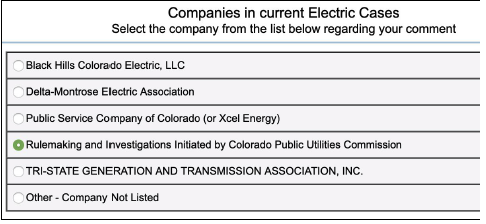
3. Select “19R-0408E – Proposed Rules Implementing ERP for Wholesale Coops”

4. Enter your information, write your comment, and attach any relevant documents. Then, click submit and you’re done!